| Today's Numbers | |
|---|---|
| GFLOP/s | 7974883 |
| GHz-Days | 3987442 |
| CPUs & GPUs | 3234651 |
| Previous Day Stats | |
|---|---|
| Newly Factored | 46 |
| First Prime Tests | 2859 |
| Verified Prime Tests | 3151 |



| Today's Numbers | |
|---|---|
| GFLOP/s | 7974883 |
| GHz-Days | 3987442 |
| CPUs & GPUs | 3234651 |
| Previous Day Stats | |
|---|---|
| Newly Factored | 46 |
| First Prime Tests | 2859 |
| Verified Prime Tests | 3151 |
M(82589933) was discovered in December 2018. It took more than seven and half years to re-check every smaller Mersenne number to make sure no errors were made during inital testing. This is a very important milestone for the GIMPS project. Many dedicated GIMPS volunteers participated in this effort. The next Mersenne milestone will require a significant effort, please consider joining this important double-checking task.
M(77232917) was discovered seven and half years ago. Now, thanks to the diligent efforts of many GIMPS volunteers, every smaller Mersenne number has been successfully double-checked. Thus, M(77232917) officially becomes the 50th Mersenne prime. This is a significant milestone for the GIMPS project. The next Mersenne milestone is not far away, please consider joining this important double-checking effort.
M(74207281) was discovered nine and half years ago. Now, thanks to the largely unheralded and dedicated efforts of thousands of GIMPS volunteers, every smaller Mersenne number has been successfully double-checked. Thus, M(74207281) officially becomes the 49th Mersenne prime. This is a significant milestone for the GIMPS project. The next two Mersenne milestones are not far away, please consider joining this important double-checking effort.
October 21, 2024 — The Great Internet Mersenne Prime Search (GIMPS) has discovered a new Mersenne prime number, 2136279841-1. At 41,024,320 digits, it eclipses by more than 16 million digits the previous largest known prime number found by GIMPS nearly 6 years ago.
Luke Durant, GIMPS most prolific contributor using free GIMPS software, proved the number prime on October 12. After notifying the GIMPS server, GIMPS began a rigorous process of independently confirming the prime number on several different hardware platforms using several different programs. This process concluded on October 19th.
This prime ends the 28 year reign of ordinary PCs finding the largest known prime. In 2017, Mihai Preda authored Mersenne prime search software that runs on GPUs. GPUs were primarily used in PCs as video cards or for mining cryptocurrency. Nowadays, video cards are also used to power the AI revolution. Durant's idea was to use these powerful GPUs that are now available in the cloud and heavily discounted when they are being under-utilized. Luke organized these cloud GPUs creating a kind of "cloud supercomputer" spanning 17 countries. After nearly a year of testing, Luke finally struck paydirt. On October 11, an NVIDIA A100 GPU in Dublin, Ireland, reported that M136279841 is probably prime. On October 12, an NVIDIA H100 in San Antonio, Texas, USA, confirmed primality with a Lucas-Lehmer test.
Luke, a 36 year-old researcher from San Jose, CA, and former NVIDIA employee, is one of thousands of GIMPS volunteers contributing spare CPU and GPU time in hopes of making a little bit of history. Mihai Preda, and later George Woltman, wrote the GPU software. Aaron Blosser keeps the GIMPS server running smoothly. This discovery is also made possible by the combined effort of each and every GIMPS volunteer testing Mersenne numbers that did not turn out to be prime. In recognition of all the above, official credit for this discovery goes to "L. Durant, M. Preda, G. Woltman, A. Blosser, et al."
The new prime is only the 52nd known Mersenne prime ever discovered. Mersenne primes were named for the French monk Marin Mersenne, who studied these numbers more than 350 years ago. GIMPS, founded by George Woltman in 1996, has discovered the last 18 Mersenne primes. Volunteers download a free program to search for these primes, with a $3000 award offered to anyone lucky enough to find a new prime. Prof. Chris Caldwell maintained an authoritative web site on the largest known primes, and wrote an excellent history of Mersenne primes.
You can read a little more in the press release.
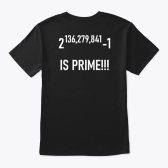

Viliam Furik, who organized the production and distribution of GIMPS polo shirts several years ago, has set up a store where you can purchase GIMPS hoodies, t-shirts, mugs, and decals. Profits directly support the mission of GIMPS. Sadly, no polo shirts yet.
Version 30.19 is now available. ECM stage 2 is now much faster if you can give prime95 lots of memory to use. This is similar to the improvements to P-1 stage 2 in version 30.8. There are other minor bug fixes and tweaks. This is not a required upgrade -- version 30.3 and later can be used to hunt for new Mersenne primes. Should you decide to upgrade, if any workers are currently in ECM or P-1 stage 2 wait for ECM or P-1 to finish before upgrading. If you have any upgrade questions, ask in this thread at Mersenne Forum.
One year ago, first-time PRP primality testing with proofs was introduced. It has been a huge success, saving GIMPS tens of thousands future double-checks. Going forward, the server will no longer make available exponents for first time Lucas-Lehmer tests. Users that have not yet upgraded to Prime95 version 30.3 (or newer) or PRPLL for GPUs should do so. Failure to upgrade will result in unnecessary double-check work. GIMPS has a multi-year backlog of double-checks to work through. There is even a chance that a new Mersenne prime is hidden in all those double-checks.
The server will continue to accept Lucas-Lehmer results. There is no need to worry about any LL tests that are currently underway.
For almost 25 years, GIMPS has looked for new Mersenne primes by running a primality test on one computer and later running the exact same primality test on another computer to guard against hardware errors having corrupted the first primality test.
A breakthrough by Krzysztof Pietrzak makes it possible to eliminate the second primality test! The first primality test produces a proof file that can be securely verified with less than 0.5% of the work required to re-run the primality test. This breakthrough will nearly double GIMPS' throughput in the long run.
Version 30.3 is now available with PRP proofs. While not a required upgrade, at some point in the future only users running version 30.3 with PRP proofs will be assigned first-time primality tests. Should you run into any problems, support is available at this thread at Mersenne Forum.
Many thanks to Mihai Preda for discovering the paper on the breakthrough and realizing its importance to the GIMPS project. Also, thanks go to Pavel Atnashev for important ideas on adapting the discovery for use by GIMPS.
SRBase has created a BOINC project to hand out trial factoring assignments on large Mersenne numbers. These are very quick work units. To get the most of the BOINC client without any issues, a FAQ at the SRBASE forum is available.
Note that there’s no way to individually credit SRBase users in GIMPS trial factoring stats. All work is credited to GIMPS user SRBase.
GIMPS forums — Here you can chat with fellow GIMPS members, get help with installation questions, learn more about how GIMPS works, etc.
You could discover one of the most coveted finds in all of Mathematics - a new Mersenne prime number. We've found eighteen already. Join in on this fun, yet serious research project. All you need is a personal computer, patience, and a lot of luck.
In addition to the joy of making a mathematical discovery, you could win a (USD) $3,000 cash GIMPS Research Discovery Award for each Mersenne prime discovered, and the Electronic Frontier Foundation is offering a $150,000 award to the first person or group to discover a 100 million digit prime number! See how GIMPS will distribute this award if we are lucky enough to find the winning 100 million digit prime.
Prime numbers have long fascinated amateur and professional mathematicians. An integer greater than one is called a prime number if its only divisors are one and itself. The first prime numbers are 2, 3, 5, 7, 11, etc. For example, the number 10 is not prime because it is divisible by 2 and 5. A Mersenne prime is a prime of the form 2P-1. The first Mersenne primes are 3, 7, 31, 127 (corresponding to P = 2, 3, 5, 7). There are only 52 known Mersenne primes.
GIMPS, the Great Internet Mersenne Prime Search, was formed in January 1996 to discover new world-record-size Mersenne primes. GIMPS harnesses the power of thousands of small computers like yours to search for these "needles in a haystack".
Most GIMPS members join the search for the thrill of possibly discovering a record-setting, rare, and historic new Mersenne prime. Of course, there are many other reasons.